
In this forward-looking episode, we explore why skills-based hiring has become a strategic imperative for CHROs navigating an AI-first world. By shifting the focus from traditional degrees to verifiable competencies and agile HR tech, leaders can build a workplace culture that prioritizes adaptability and high-level performance. This approach not only enhances wellbeing by aligning talent with purpose but also drives exponential gains in organizational productivity.
🎧 CLICK THE PLAY BUTTON ABOVE TO LISTEN TO THIS EPISODE 👆
Here’s a summary of this episode:
The hiring landscape is undergoing a seismic shift. As AI reshapes how candidates present themselves and how work gets done, CHROs face a critical question: How do we build talent strategies that are both AI-ready and fundamentally human?
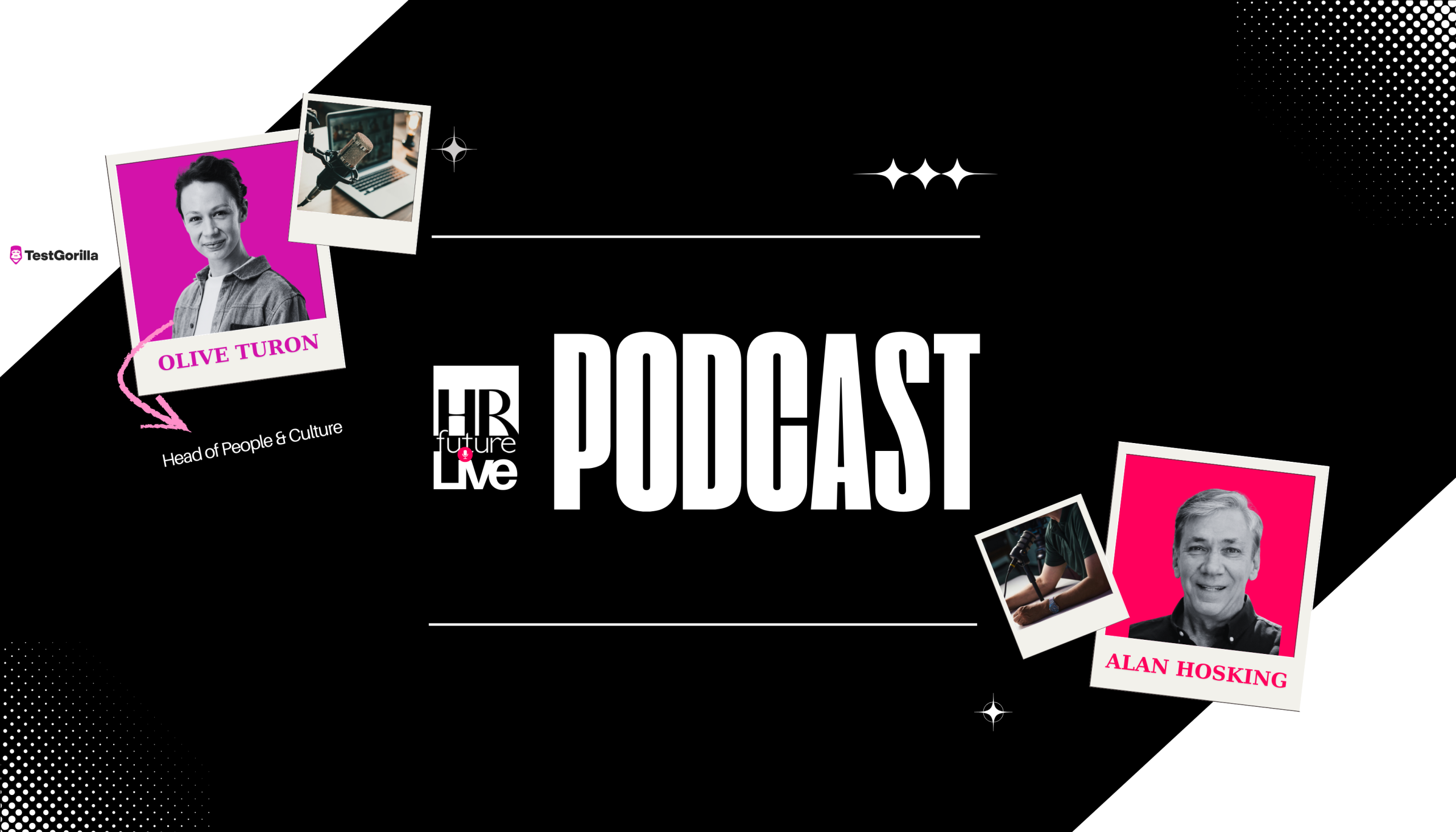
Olive Turon, Head of People and Culture at TestGorilla, offers a compelling answer. In a recent conversation for HR Future Live’s podcast, she laid out a vision that challenges conventional wisdom while providing practical pathways forward.
The CV Crisis: AI Exposed What Was Already Broken – CVs Are Becoming Obsolete, Skills Aren’t
One of the strongest themes from the conversation is this: traditional CVs and cover letters have never been strong predictors of job performance – and AI is exposing that weakness at scale.
Why this matters:
-
AI-generated CVs and cover letters make it even harder to assess authenticity.
-
The risk isn’t that AI changes the candidate – it’s that it exposes how unreliable CVs have always been.
-
Skills-based hiring is now the only defensible hiring model.
What CHROs should do:
-
Shift assessment toward validated skills and real work samples.
-
Implement role-specific skills tests early in the funnel.
-
Reduce reliance on unstructured interviews and subjective “impressions.”
-
Prioritise outcomes over written inputs.
The bottom line:
Skills-based hiring isn’t a trend – it’s a survival strategy in an AI-first world.
AI-generated applications are throwing talent acquisition teams into headspins worldwide. But according to Turon, this isn’t a new problem – it’s an old one finally getting the spotlight it deserves.
“CVs have always been a bit nebulous as a tool,” Turon explains. “There’s no one fact-checking a CV. They aren’t scientifically validated or necessarily even correlated with the skills that people have.”
AI didn’t create this flaw; it simply amplified it. The real issue? Hiring processes that have always rewarded style over substance. When your evaluation method relies on written outputs, it doesn’t matter whether a human or a machine polished the prose.
The strategic shift: Move from credential-based to competency-based evaluation. If you’re testing for actual job-related skills, it becomes irrelevant whether AI helped write a cover letter.

Building an AI-Competent Workforce: Beyond the Technical
Every CHRO today faces the mandate to build AI capabilities. But Turon argues this requires a dual approach that many organizations are missing. But the reality described in the conversation is far more empowering: AI removes the admin that drains HR’s time and prevents strategic value.
Olive’s team already sees:
-
Manual onboarding steps eliminated
-
Repetitive admin automated
-
Senior HR professionals producing more impact
-
No increase in workload – only an increase in value
For CHROs, this means:
-
The era of HR drowning in admin is ending
-
AI is an amplifier, not a replacement
-
HR can finally move into strategic work at scale
A mindset shift is essential:
Curiosity over fear. Proactivity over hesitation. Optimism over anxiety.
Yes, you need to assess technical AI competencies – the ability to work with automation, build AI agents, or integrate AI into core workflows. But here’s the insight most organizations overlook: human skills become more valuable, not less, in an AI-first world.
“Robots can’t do those really core human pieces,” Turon notes. Critical thinking, communication, problem-solving, and adaptability – these “evergreen skills” differentiate high performers when routine tasks get automated.
Action for CHROs: Redesign your assessment frameworks to evaluate both AI literacy and human capabilities. The candidates who can leverage AI while bringing irreplaceable human judgment are your future leaders.
Overcoming HR’s AI Reluctance: A Mindset Shift
Turon acknowledges that HR has traditionally been resistant to technological change. But she frames this as an opportunity, not an obstacle.
“We can largely decide what mindset we approach change with, and that will have a huge impact on how successful we are,” she says. “AI is coming. We’re powerless to stop it. Any change brings uncertainties and anxieties. It also brings a lot of opportunities.”
Her own team’s experience proves the point. By introducing AI-driven automation to eliminate manual, administrative tasks, she freed senior HR professionals to create strategic impact without increasing workload.
The reframe: AI isn’t replacing HR – it’s liberating HR from tasks that have held the profession back. While product and engineering teams automated boring work years ago, HR has been trapped in manual processes. That changes now.
The Skills CHROs Must Prioritise Are Not Just Technical
AI is driving demand for AI competency, but the conversation highlights an even more important insight: AI makes human skills more valuable, not less.
These skills are becoming core organisational competencies:
-
Adaptability
-
Critical thinking
-
Communication
-
Problem-solving
-
Leadership and influence
-
Growth mindset
These are not “nice-to-have soft skills.” They are measurable, assessable, and directly correlated to job performance.
CHROs should:
-
Integrate critical thinking and problem-solving assessments into hiring
-
Create learning pathways for adaptability and continuous learning
-
Build leadership programmes focused on communication and decision-making
-
Re-design performance management to reward learnability
The Retention Revolution: Learning Agility as Currency
Looking ahead, Turon sees 2025 as a pivotal year where companies move from AI readiness to AI integration. This creates both risk and opportunity for retention strategies.
The risk? Companies are rushing to phase out existing employees and hire “AI-ready” talent from outside.
The smarter approach? Identify people with learning agility and invest in their development.
“Find those people who’ve got those human skills, that ability to learn, who are generalists who’ve pivoted in different roles,” Turon advises. “Those are the people who are excited and motivated by new opportunities.”
Organisations are in a “readiness phase,” preparing for AI transformation. But as AI becomes embedded in operating models, mobility will accelerate across the labour market.
CHROs must consider:
-
Which employees have the ability to learn, pivot and adapt
-
Which roles will evolve — not disappear
-
How to retain high-potential talent during transformation
Retention priorities for 2025+:
-
Create AI development pathways for current employees
-
Identify employees with high learnability and generalist profiles
-
Offer stretch opportunities as retention levers
-
Communicate a transparent roadmap for AI integration
Retention will shift from perks to growth – employees stay where they can evolve.
Use AI upskilling as a retention tool. People who can learn and adapt are more valuable than people who happen to have today’s hot skills – because today’s skills will be obsolete tomorrow.
Strategic imperative: Build robust learning and development programs that help your existing talent grow AI capabilities. This is more sustainable than constant external hiring and preserves institutional knowledge.
From Resources to Strategy: HR’s Evolved Mission
Your talent strategy must prepare for dual realities. Turon’s perspective on HR itself is telling. She frames the function as “using resources to help companies succeed” and ensuring that “people remain super strategic and super valuable in reaching company goals.”
This isn’t HR as an administrative function. This is HR as a strategic architect of competitive advantage in an AI-augmented future.
The tools exist. TestGorilla’s skills-based assessments provide scientifically validated measurements of both technical and human capabilities. AI can handle the manual tasks that have consumed HR bandwidth for decades.
What’s needed now is leadership – CHROs willing to redesign hiring processes, invest in development over credentials, and champion both AI adoption and human excellence.
The future workforce will require two equally critical skill sets:
1. Technical AI fluency
Not just engineers, but marketers, HR professionals, product teams, and operational roles.
2. Deep human capability
Empathy, influence, strategic thinking, resilience. Companies that invest in both will dominate. Companies that invest in only one will be disrupted.
Advice for the Future Workforce – and What HR Should Look For
Younger talent entering the workforce often underestimates their problem-solving skills. HR leaders should rethink how they evaluate early-career candidates.
Practical steps:
-
Look for evidence of real problem-solving in lived experiences, not job titles
-
Encourage candidates to reflect on moments they solved dilemmas, worked in teams, prioritised or overcame constraints
-
Use structured interviews to draw out cognitive skills
-
Direct candidates to self-assess through skills tests (e.g., problem-solving, critical thinking, AI competency)
This reduces bias and builds confidence – while surfacing true potential.

The Bottom Line
The hiring landscape isn’t just changing – it’s being rebuilt from the ground up. CHROs who cling to CV-based, credential-focused hiring will find themselves with workforces unprepared for the future.
Those who embrace skills-based hiring, assess for both AI competency and human capabilities, and build cultures of continuous learning will create organizations that don’t just survive disruption – they harness it.
As Turon puts it: “Being able to hire based on skills is more important now than it’s ever been.” The question for every CHRO is simple: Are you ready to lead that transformation?