
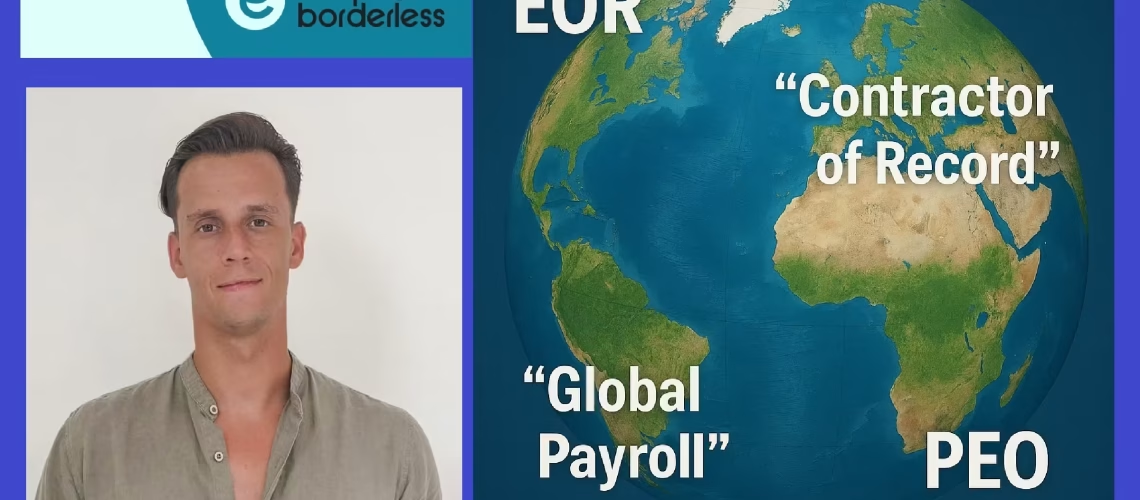
A finding I see companies run into consistently is picking the wrong global hiring model because the terminology is unclear. EOR, PEO, global payroll, contractor of record. Vendors use these terms interchangeably. Advisors mix them up. The result is companies ending up with compliance gaps they did not anticipate. From research, I have built a taxonomy using four dimensions to separate each model: who is the legal employer, whether the client needs a local entity, how portable the structure is across jurisdictions, and whether co-employment or shared liability exists.
Here is what the research found
Four models. Four different things.
These are not variations of the same service. They have different legal structures, different compliance implications, and different use cases. Treating them as interchangeable is how companies end up with gaps in their employment structure.
EOR: the only model that solves the no-entity problem
Employer of record is the only model where the intermediary becomes the full legal employer under local law. The EOR issues the employment contract, runs payroll, handles tax, and takes on compliance responsibility. The client directs the work but holds no direct employment relationship with the worker.
No local entity is required on the client side. The model works across most countries. It is the right choice when a company wants to hire someone abroad without setting up a local legal entity.
One important limit: some countries cap how long an EOR can be used for the same worker. Germany limits this to 18 months. Going beyond that without a review creates a risk of the client being treated as the direct employer, with back-liability attached.
PEO: designed for the US, not the world
Professional employer organisation means co-employment. The company and the PEO are both employers simultaneously, with responsibilities split by a written agreement. The IRS recognises this in the US. It works cleanly there.
Outside the US, co-employment is not a recognised legal concept in most countries. When a vendor sells global PEO, what they are almost always selling is an EOR arrangement. The co-employment structure does not hold internationally.
This is a meaningful distinction. A company that believes it has transferred employer liability to a global PEO provider in Germany or Singapore, where co-employment has no legal standing, has not transferred anything. The liability remains with the client.
Global payroll: the admin layer, not the employment layer
Global payroll does not make anyone the employer. The client remains the legal employer in every country. The provider handles payroll calculation, tax remittance, and statutory reporting.
A legal entity is still required in every country where the company has workers. Global payroll does not solve the no-entity problem. It handles the operational layer once that problem is already resolved.
Many companies use EOR and global payroll alongside each other. EOR covers markets where no entity exists. Global payroll handles the markets where one does.
Contractor of record: for genuine contractors, not a substitute for EOR
Contractor of record is designed for genuinely independent contractors. No employment relationship exists. The COR holds the commercial contract, manages classification checks, processes payments, and maintains the documentation regulators look for.
The operative word is genuinely. COR does not fix a misclassified relationship. If the company directs someone’s daily work, provides their equipment, and they work exclusively for that company, most jurisdictions will treat that as employment regardless of what the contract says. Using a COR in that situation documents the arrangement without resolving the underlying classification risk.
The decision framework
Two questions determine the right model. First: is this worker an employee or a genuine independent contractor? Classification follows how the relationship actually operates, not how it is labelled.
Employee, no local entity – use EOR
Employee, local entity exists – use global payroll, or domestic PEO if US-based
Genuine independent contractor – use COR
Contractor relationship that functions like employment – use EOR
Why this matters
Each wrong choice carries a specific consequence. A company using global payroll, expecting employment liability coverage in a new market, has no legal employer on record there. A company relying on global PEO internationally, assuming co-employment applies, has not reduced its exposure. A company using COR for a relationship that functions as employment has created documentation of a compliance problem rather than a resolution to it.
These are not edge cases. They are the most common mistakes I see companies make when hiring internationally. The terminology is where the confusion starts. Getting it right makes the rest of the decision straightforward.
The full paper is available on Zenodo: https://doi.org/10.5281/zenodo.18861073
About the author
Robbin Schuchmann is co-founder of Employ Borderless, an independent advisory platform for global hiring solutions, headquartered in Singapore. He runs international business operations and digital marketing, and has spent over a decade working across global hiring, EOR, PEO and payroll.