

Every year, the list of states where companies feel comfortable hiring gets a little shorter. This is not because there are fewer jobs or that the talent isn’t there. It’s because somewhere between finding the right candidate and getting them to day one, the compliance math stops adding up.
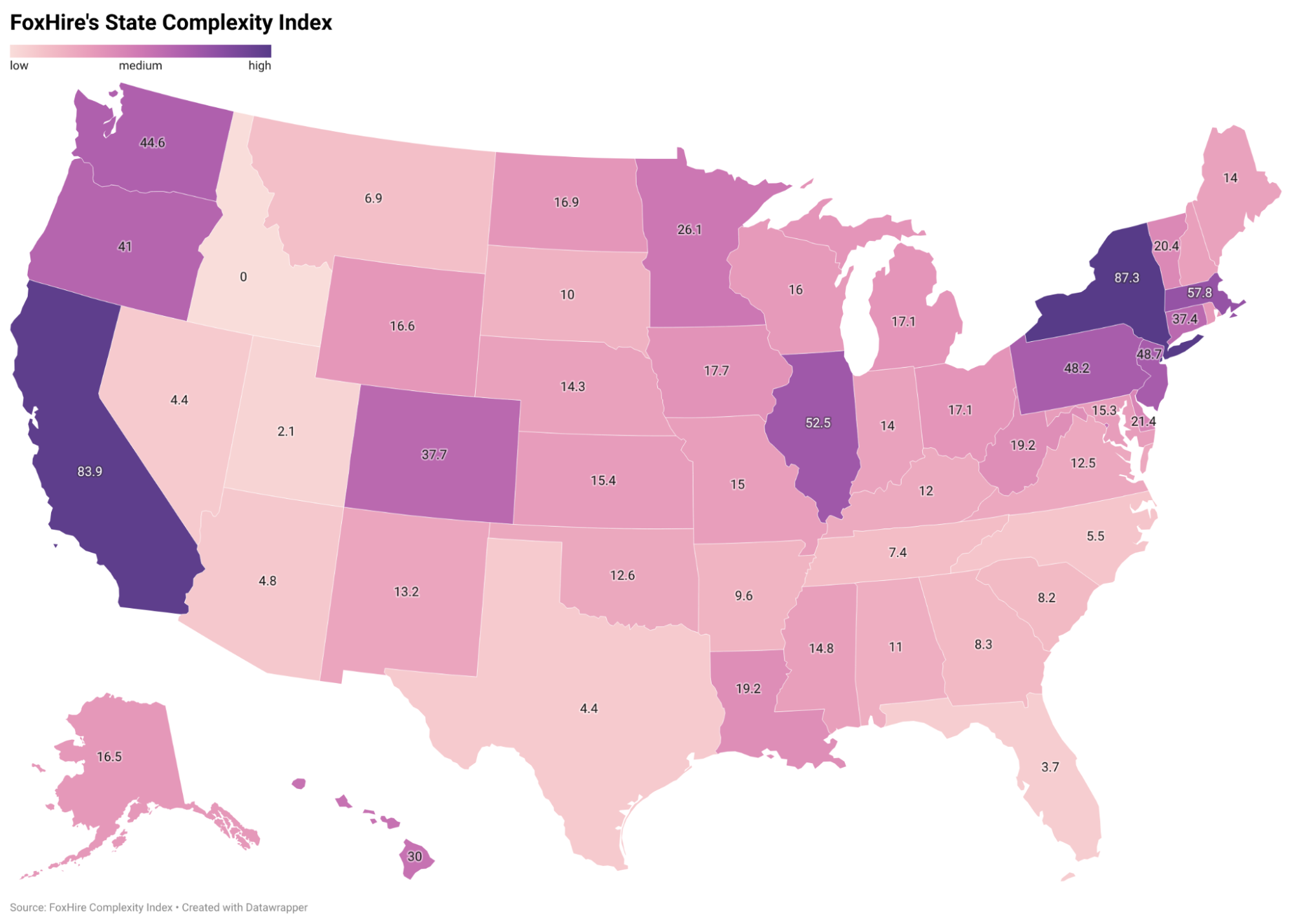
A new index from FoxHire, an employer of record (EOR) platform, quantified that reality. Surveying HR, payroll, staffing, and business professionals who hire across multiple U.S. states, the Multi-State Hiring Compliance Burden Index documents what many in the industry already know but rarely say out loud: state employment laws have become one of the most significant, least-discussed barriers to hiring in the country.
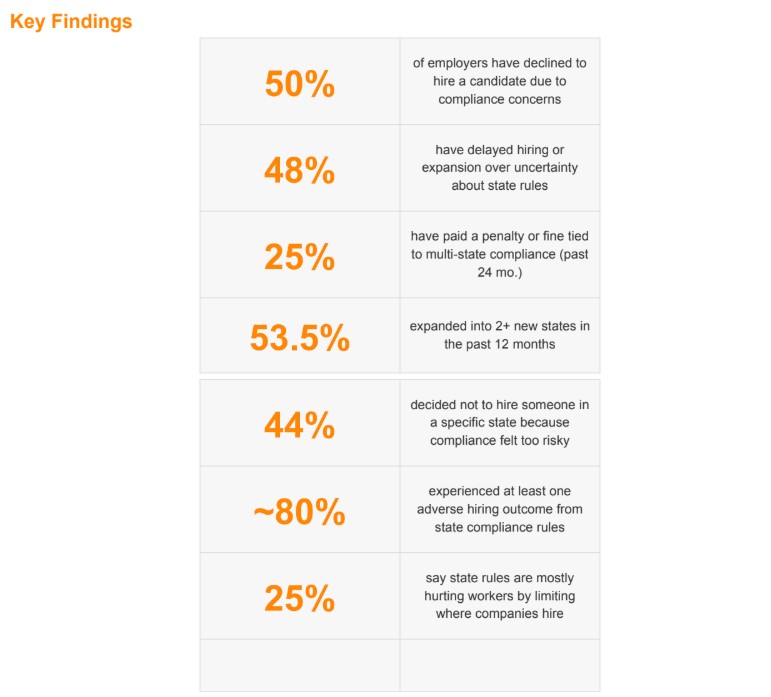
Half of employers have turned away a qualified candidate because of the state they live in. Nearly half have delayed a hire because the rules weren’t clear enough to move forward. One in four have already paid a fine for getting it wrong.
The problem is not that companies don’t want to hire broadly. It’s that the infrastructure required to do it keeps getting more complicated, and most teams are absorbing that load with limited resources and no clear end in sight.
Half of Employers Have Turned Away Candidates Over Compliance Concerns
This is the stat that should give pause. One in two employers has told a qualified candidate they could not be hired because of the state they live in.
That conversation tends to happen late, after both sides have put in real time. It does not make headlines, and it does not show up in unemployment figures. But it is a structural barrier to employment built not on a person’s qualifications, but on their zip code.
The core issue is a mismatch. Remote work opened the door to national recruiting, but employment law never followed. Every state has its own classification rules, wage standards, pay transparency requirements, and tax registration obligations. When the compliance burden of hiring in a particular state outweighs the benefit of a single candidate, many companies move on and the candidate rarely finds out why.
Getting Compliant in a New State Takes Longer Than Most Companies Plan For
More than half of respondents expanded into at least two new states in the past year. COVID-19 accelerated multi-state hiring faster than most organizations anticipated, and where companies look for talent has changed permanently.
What has not changed is how long it takes to get compliant once you cross a state line. Each new state triggers its own chain of requirements: tax registrations, unemployment insurance accounts, wage law reviews, local posting obligations, and payroll system updates. None of it happens overnight. For more than a third of employers, the honest answer to the question “Are we compliant?” is still “not yet.”
Nearly half of the respondents delayed a hiring decision because the regulatory picture in a given state was not clear enough to move forward. One in five pushed back a candidate’s start date just to get the paperwork in order. In a market where speed matters and candidates have options, that kind of delay costs companies real hiring opportunities.
California and New York Create Problems for Every Department, Just for Different Reasons
The most telling finding in this index is not which states ranked highest. It is that California and New York appear at the top of every professional group’s list, regardless of role. Recruiters, benefits administrators, and legal and compliance teams flag them. Each group arrives at the same answer through a completely different set of daily frustrations.
Among all employers, California leads with 36%, calling it the hardest state to stay compliant in, followed by New York at 33%. But among recruiting professionals, New York edges ahead, 40% to California’s 38%. Recruiters deal with pay transparency laws before a job offer ever goes out. New York’s requirements kick in early and are detailed enough that compliance becomes part of the job posting process, not just the offer stage.
Benefits administrators tell a different story. New York leads the list too (36%), with California second (31%), but Pennsylvania, Massachusetts, and Washington also show up prominently. For this group, the challenge is not the hiring moment. It is everything that follows. Paid leave programs, sick time accrual, health coverage requirements, and ongoing filing obligations all vary by state and keep changing as new laws pass.
For legal, risk, and compliance professionals, California takes the top spot at 35%. Their concern is liability, not logistics. California’s employment laws are strict and specific enough that unintentional violations happen regularly. New Jersey and Massachusetts follow, not because of the volume of rules, but because of what happens when those rules are broken. Both states have reputations for aggressive enforcement and courts that tend to side with employees.
When every department independently lands on the same two states, it points to something broader than departmental friction. California and New York create work at every stage of employment, from job posting to onboarding to ongoing administration to potential litigation. For multi-state employers, that is not a coincidence. It is a pattern worth planning around.
One in Four Companies Has Already Been Fined for Multi-State Compliance Errors
The compliance burden in this index is not theoretical. One in four respondents has already paid a penalty, fine, or interest charge tied to multi-state compliance in the past two years. And that figure likely understates the real rate, since many compliance errors go undetected until an audit turns them up.
Payroll is where most of the exposure lives. Nearly a third of respondents say payroll taxes and registrations produce more compliance work than anything else, and 30% say payroll mistakes are their biggest fear when entering a new state. A missed withholding registration or a miscalculated local tax can trigger state penalties and create underpayment problems for employees at the same time. Both risks factor directly into decisions about where to hire.
Most companies are handling this with software, not specialists. 42% rely primarily on payroll software to manage their multi-state obligations. Only 17% have ongoing external support for routine compliance work. Payroll software handles a lot well: it calculates rates, tracks withholding rules, and cuts down on manual errors. But applying rules is not the same as interpreting them. Software cannot assess how aggressively a state enforces violations, or make judgment calls when the rules leave room for interpretation. For the one in four employers already penalized, that gap has proven expensive.
The Rules Have Not Caught Up to the Way Companies Actually Hire
Hiring has gone national. Employment law has not. That gap is the common thread running beneath every finding in this index.
Companies are expanding into new states, recruiting remote talent across the country, and trying to move fast in a competitive market. Behind the scenes, HR, payroll, and legal teams are absorbing an expanding set of state-specific requirements, each with its own rules, timelines, and consequences for getting it wrong.
The result shows up in delayed offers, rejected candidates, pushed-back start dates, and actual fines. None of those outcomes make the news. They are just the cost of a national labor market still running on a patchwork of local rules.
“Hiring has gone national, but employment law largely has not. Organizations are expanding across state lines faster than their compliance systems can keep up. This research reflects what we see every day: companies want to hire, but the regulatory patchwork is forcing difficult decisions about where they can do it confidently.” — Colin LaBeau, President, FoxHire
Until employers are better equipped to navigate that patchwork, or until the rules themselves become more consistent, the compliance burden will keep shaping who gets hired, where, and when.
Summary
Companies are hiring across state lines faster than ever. The rules governing those hires have not kept up.
A new national index from FoxHire surveyed HR, payroll, staffing, and business professionals who place or employ workers across multiple U.S. states. What it found is a workforce reality where state employment laws have become one of the biggest obstacles to getting someone hired.
Nearly half of employers have delayed a hiring decision because the rules in a given state were not clear enough to move forward. One in two have turned away a qualified candidate entirely. Not because of their skills. Because of where they live.
Read the full study here: https://www.foxhire.com/blog/multi-state-hiring-compliance-burden-index
Methodology
The Multi-State Hiring Compliance Burden Index draws on a national survey of HR, payroll, staffing, and business professionals who employ or place workers across multiple U.S. states. The survey was conducted via Pollfish. Respondents were asked about expansion activity, compliance challenges, hiring delays, tool usage, and direct experiences with penalties and fines. The study gathered input from recruiters, benefits administrators, and legal and compliance professionals to show how multi-state hiring complexity looks different depending on where someone sits within an organization.
Guest writer