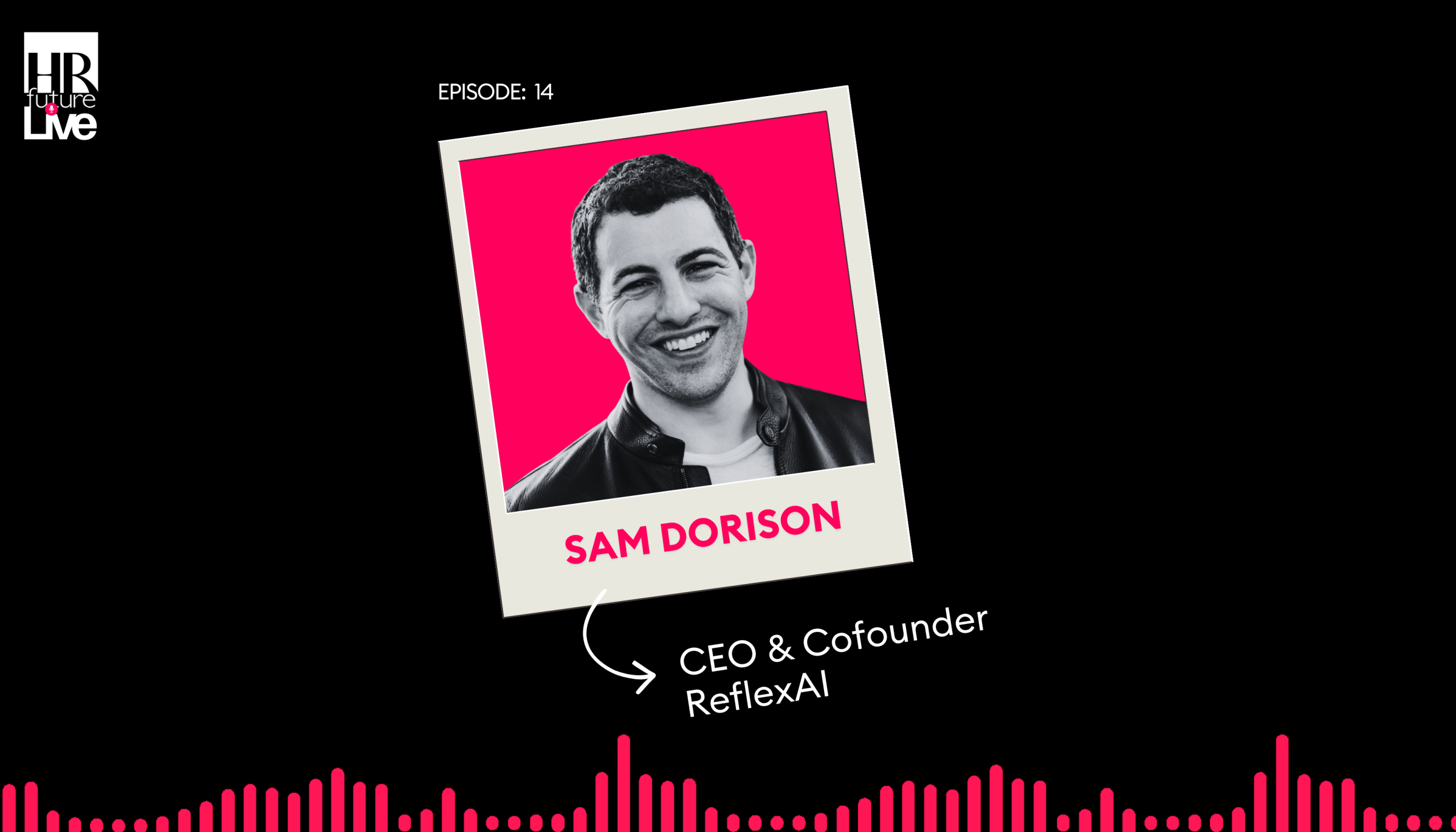

In this episode, we provide a practical playbook for CHROs to move their workforce from AI anxiety to AI advantage by the year 2026. By addressing the human fears of displacement and fostering a workplace culture of continuous learning, HR leaders can align AI integration with human wellbeing to drive exponential productivity and peak performance.
As organisations accelerate into 2026, AI is no longer a distant disruptor – it’s already reshaping how work gets done. Yet for many Chief Human Resources Officers, the conversation still oscillates between excitement and anxiety.
In a recent episode of the HR Future Live Podcast, Sam Dorison, CEO and co‑founder of ReflexAI, offered a grounded, optimistic – and highly practical – perspective on what AI really means for people, performance, and the future of work. His insights hold particular relevance for CHROs tasked with bridging operational reality and strategic ambition.
This article distils the most important lessons from the conversation and translates them into actionable guidance for HR leaders who want to move from experimentation to impact.
The Biggest Myth Holding Organisations Back
One of the most persistent misconceptions about AI in the workplace is the belief that we are already living in an “AI-powered workforce.” We’re not.
Most organisations today are still dabbling – using AI sporadically, inconsistently, and often outside of core workflows. According to Dorison, the real productivity gains are still ahead of us, not behind us.
This distinction matters. When AI is treated as a bolt-on tool rather than embedded infrastructure, it fails to change how work actually happens. For CHROs, this means the opportunity is not about reacting to disruption, but actively shaping what comes next.
Key takeaway for CHROs: AI maturity is not about adoption – it’s about integration.
AI Isn’t Replacing Jobs – It’s Redesigning Them
The fear that AI is “coming for jobs” remains deeply ingrained. Dorison offers a counterpoint rooted in history: productivity gains have consistently led to more employment, not less.
AI changes roles, expectations, and skill mixes, but it also increases the capacity of teams. When used well, AI enables organisations to do more, faster, and at higher quality. That often creates demand for more people, not fewer.
The real shift is not job loss – it’s job evolution.
CHRO lens: Workforce planning must focus less on job elimination and more on role redesign, capability uplift, and internal mobility.
What “Using AI Well” Actually Looks Like
Dorison draws a sharp line between AI experimentation and AI effectiveness.
Using AI well requires three things:
1. Workflow Integration
AI must live inside how work gets done. If employees are copying and pasting between systems or duplicating effort just to use AI, adoption will stall. High-impact tools are those embedded directly into daily workflows.
2. Organisational Self-Awareness
Different organisations need different AI strategies.
- Less regulated environments may empower leaders to choose and test their own AI tools.
- Highly regulated organisations may rely on pre-approved platforms and central governance.
Both approaches are valid – but they require different leadership profiles.
Hiring implication: CHROs must clearly define what “AI leadership” means in their context before hiring for it.
3. Clarity on Accountability
AI should accelerate performance, not excuse poor outcomes. Teams remain accountable for quality, even when AI is involved.
A powerful practice: Set explicit expectations that AI should improve outcomes by a defined margin (for example, a 10% improvement in quality, speed, or efficiency).
HR’s Strategic Moment: From Policy Enforcer to Role Model
One of the strongest messages from the conversation is this: HR cannot ask the organisation to change if it isn’t changing itself.
CHROs and HR teams have a unique opportunity to role model responsible, high-impact AI usage.
Practical Ways HR Can Lead by Example
- Use AI to improve internal communications before sending them organisation-wide
- Pressure-test messaging for clarity, tone, and unintended consequences
- Enhance performance review narratives with structured AI feedback
- Improve hiring and onboarding consistency using AI-supported tools
Importantly, this is not about automation without oversight. It’s about augmentation with judgement.
Cultural signal: When HR visibly uses AI thoughtfully, it legitimises adoption across the business.
Overcoming Resistance Without Creating Risk
Most organisations have moved from asking if AI matters to how to use it safely.
Resistance now tends to fall into two camps:
- Leaders who want to move fast and learn through experimentation
- Leaders who want to minimise risk and avoid mistakes
CHROs sit at the centre of this tension.
A Low-Risk, High-Impact Approach
Instead of pushing radical transformation, Dorison recommends incremental improvement.
A simple but powerful example:
Ask every team how they have used AI to improve one meaningful metric by 10% over the year.
This framing:
- Encourages experimentation
- Preserves accountability
- Avoids reckless shortcuts
- Creates measurable progress
Set the expectation early in the performance cycle—not weeks before reviews.
AI, Mental Health and the Human Core of Work
Despite all the technology, one truth remains unchanged: human connection is irreplaceable.
In mental health, frontline services, and emotionally complex roles, AI is being used not to replace people – but to prepare and support them better.
Examples include:
- AI-powered training simulations
- Real-time feedback aligned to clinical or ethical standards
- Quality assurance across 100% of interactions rather than small samples
The result? Better prepared employees, faster skill development, and reduced emotional load.
Critical insight: AI works best when it strengthens human capability – not when it attempts to substitute it.
Capabilities CHROs Should Prioritise Now
Based on the discussion, three priorities stand out:
Start Hiring For
- Leaders who can inspire and motivate teams to use AI effectively
- Strong critical thinkers who can assess trade-offs, risks, and opportunities
Stop Over-Indexing On
- Candidates with the most AI tools on their CV but limited leadership or judgement
AI fluency can be taught. Strategic thinking and influence cannot.
One Final Responsibility: Holding AI Vendors Accountable
As AI vendors flood the market, CHROs must apply the same rigour they would to any enterprise technology.
This includes asking:
- How is our data protected?
- What compliance standards are met?
- How is responsible AI embedded in the vendor’s culture – not just their marketing?
Responsible AI is not a promise – it’s a practice.
The Bottom Line for CHROs
The experimentation phase is over.
Your competitors who figure out true AI integration – where tools fit seamlessly into workflows, where accountability remains clear, where humans are empowered rather than replaced – will achieve productivity gains that enable growth, hiring, and market expansion.
Your competitors who don’t will be stuck in experimentation mode while the market moves on.
The question for CHROs: Are you leading this transformation or reacting to it?
Are you walking the walk or just preaching about AI adoption?
Are you building the talent strategy for an AI-integrated organization or still hiring for the pre-AI world?
“The best thing you can do to regret not acting sooner is act now,” Dorison concludes.
Find low-risk starting points. Flow through the plumbing yourself. Set clear expectations. Hold teams accountable for results, not just tool usage.
Because 2026 won’t wait for you to be ready.
The organizations that get this right will wonder how they ever worked any other way.
The ones that don’t will wonder why their competitors keep pulling further ahead.
About the Expert: Sam Dorison is CEO and co-founder of ReflexAI in New York, specializing in AI strategy and high-stakes AI application deployment. His company was named one of Time’s 100 Best Inventions in 2021 as the first generative AI use case on that list. Since 2019, he’s been building AI applications for frontline teams, call centers, healthcare, and mental health organizations.