

Burnout isn’t just exhaustion; it’s a disconnection from self driven by old “survival rules” that high performers unknowingly follow. Former HR executive Rochelle Trow reveals why CHROs must stop rewarding “grit” and start creating the psychological safety required for leaders to pause and reconnect.
The intensity of some workplace reactions has very little to do with what’s happening now.
You can be experienced, grounded, and generally steady – and still find yourself reacting sharply to one particular person or moment. Your chest tightens. Your patience disappears. The reaction feels out of proportion, but it’s very real.
When you slow that moment down, something important becomes visible.
The part of you responding isn’t always your current, capable, adult self. Often, it’s a much younger version of you — one who learned, early on, what was required to stay safe, accepted, or valued.
That belief didn’t start at work.
It started much earlier.
And it was useful once.
If you learned that being agreeable kept you out of trouble, you learned to smooth over tension.
If you learned that being competent earned approval, you learned to over-function.
If you learned that visibility carried risk, you learned to stay composed and quiet – even when something wasn’t right.
These beliefs don’t disappear just because someone earns a senior title. They follow people into meetings. Into leadership. Into moments where something small suddenly feels bigger than it should.
This is where burnout actually begins.
Not with exhaustion – but with disconnection.
“I Had Everything I Wanted – And I Still Burned Out”
“I had everything I wanted. Holiday home in South Africa, two homes in the UK, a strong bank balance, status. Everybody wanted to talk to me. I was important enough.”
Rochelle Trow was at the peak of her HR executive career in London when burnout hit.
What should alarm CHROs is this: she didn’t see it coming.
On paper, she was delivering. Excelling. Progressing. But her body was telling a very different story.
“The conversation in my head was so loud it drowned everything else. It affected my sleep, my ability to connect, my ability to engage. I was absorbed – and exhausted.”
Today, as the author of Anchored: Staying Grounded When Everything Speeds Up, Trow works with leaders navigating the same pattern.
Her message challenges one of HR’s most persistent assumptions:
Burnout isn’t exhaustion. Burnout is disconnection from self.
And once you see burnout this way, the risk profile inside your organisation changes dramatically.

Your Highest Performers Are Your Highest Risk
“All those high performers constantly running – performance, performance, performance – they’re the first candidates for burnout.”
This isn’t because they can’t cope.
It’s because what drives their performance often comes from somewhere old.
When someone is relentlessly focused on output, delivery, and achievement, the real question isn’t how much they’re doing – it’s what’s driving it.
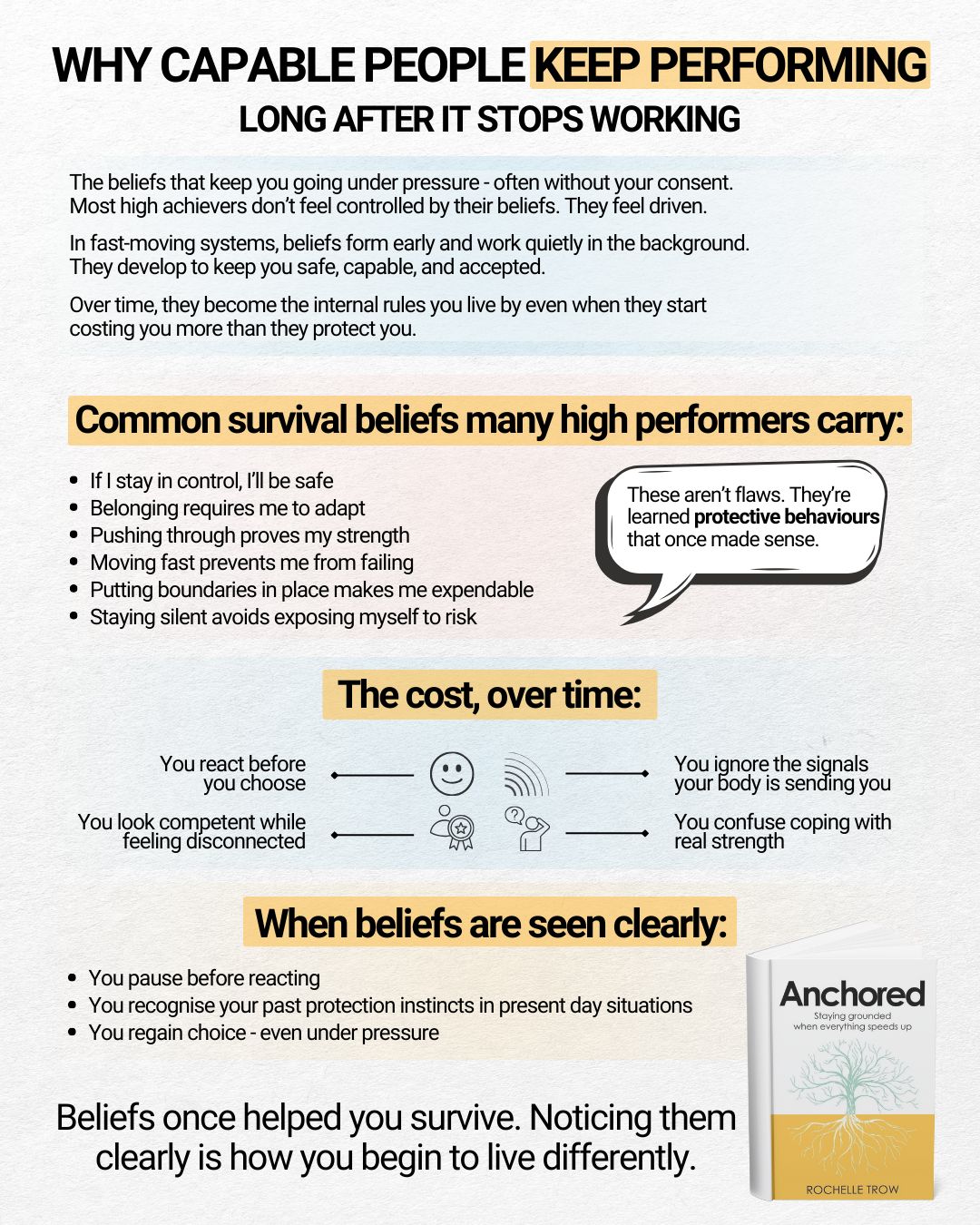
Many high performers aren’t consciously choosing to override themselves. They’re responding to internal rules that once kept them safe:
- If I perform, I’m valued.
- If I don’t stop, I can’t be replaced.
- If I stay in control, I won’t be hurt.
Those rules made sense once.
But unexamined, they become overused strengths – and eventually, breaking points.
The Dark Side of Achievement
Trow’s own drive traced back to early childhood.
As the youngest of ten children, with limited emotional availability from her mother, she learned early: survival depended on self-reliance.
“Your success depends on you. You have to shout to be heard. You can’t rely on anyone else.”
That belief system followed her into adulthood – expressed through ambition, visibility, status, and relentless momentum.
“The belief system you form as a child is there to keep you safe. But it doesn’t always work in adult environments. What once protected you becomes a double-edged sword.”
This is the pattern many organisations unknowingly reward.
Why High Performers Won’t Stop – Until They Break
“High performers don’t know about pause.”
Even when burnout is pointed out, resistance is common. Not because people are ignorant – but because stopping threatens identity.
Why the resistance?
- It touches uncomfortable truths. Slowing down often reveals beliefs people would rather not examine.
- It threatens the life they’ve built. Status, income, role, and self-worth may feel intertwined.
- Ego takes the wheel. Letting go can feel like failure, even when it’s necessary.
Trow herself left a senior role not because she couldn’t do it – but because ego couldn’t accept a reshaped position.
“My ego was louder than my common sense.”
The environment changed. The driver didn’t.
So the burnout followed.
From Head Awareness to Body Awareness
Like many executives, Trow had done the work – at least cognitively.
Leadership programmes. Executive coaches. Years of development.
“It wasn’t that I lacked self-awareness. I had it in my head.”
What was missing was the ability to feel what was happening.
True self-awareness isn’t conceptual. It’s embodied.
It shows up as tension, fatigue, irritation, reactivity. And until leaders learn to listen to those signals, insight stays theoretical.
“That awareness has to drop from your head into your body.”
For Trow, that process took four years – unraveling beliefs formed in early childhood, reinforced through education, identity, and corporate life.
What CHROs Can – and Can’t – Do
There’s a hard truth HR leaders need to face.
You cannot systemically fix burnout that is driven internally.
Organisations are built for performance, efficiency, and results. And the system will continue to reward grit, endurance, and output.
The lever isn’t control – it’s conditions.
1. Accept the Paradox
The world is not slowing down. Change is no longer episodic – it’s continuous.
Stop fighting that reality. Work with it.
2. Shift the Locus of Control
You can’t change the system – but leaders can change how they show up inside it.
That requires courage, not tools.
3. Redefine Resilience
Resilience is not pushing through.
It’s understanding what’s driving behaviour – and knowing when to pause.
4. Lead With Compassion
Compassion isn’t weakness. It’s the capacity to see what’s really happening – in yourself and others.
It changes conversations. It changes outcomes.
5. Stop Overusing Performance
One of the most overused leadership behaviours is performance itself.
Ask a better question:
How does this actually deliver what we’re trying to achieve?
Not: Can you do more?
The Question That Changes Everything
When beliefs are made visible, something shifts.
People stop asking, What’s wrong with me?
And start asking a far more powerful question:
When did I learn this – and does it still belong here?
That’s the uncomfortable conversation high performers avoid – and the one organisations quietly depend on them never having.
The Real Risk HR Must Face
Your best people aren’t burning out because they’re weak.
They’re burning out because they’re driven – often by rules that no longer fit the lives they’re living.
Burnout isn’t exhaustion.
It’s disconnection.
And no amount of leave fixes disconnection.
The only person who can stop the cycle is the person caught in it.
HR’s role is simpler – and harder:
Create the conditions where people feel safe enough to pause, reflect, and choose differently.
Because the person your high performers need to become isn’t someone new.
It’s who they were before they learned to disconnect from themselves.
About the Expert: Rochelle Trow is an HR executive, leadership coach, and author of three books including She spent 16 years at executive level before burning out and spending four years rediscovering what actually drives sustainable performance.