

LinkedIn now receives around 11,000 job applications a minute, a 45% jump in a year, and Workday’s recruiting customers processed 173 million applications in the first half of 2024, four times the growth rate of the openings underneath them.
A growing share of that volume works like this: software matches the role, writes the resume, tailors the cover letter, and submits, while on the employer side another system parses, scores, and ranks the result before anyone logs in. Two models have exchanged documents about a job neither of them will do. Whether that counts as a breakdown depends on what you still expect the resume to prove.
In this article we will discuss the tools candidates now apply with, why automation on both sides of hiring grew out of the same bottleneck rather than out of opposing camps, and what to change in a screening stack that still assumes a human wrote, and a human will read, every resume in the pile.
The data-driven reality of the 2026 job hunt market
Let us talk about how the 2026 “Hiring Winter” forced applicants to become more active and write faster.
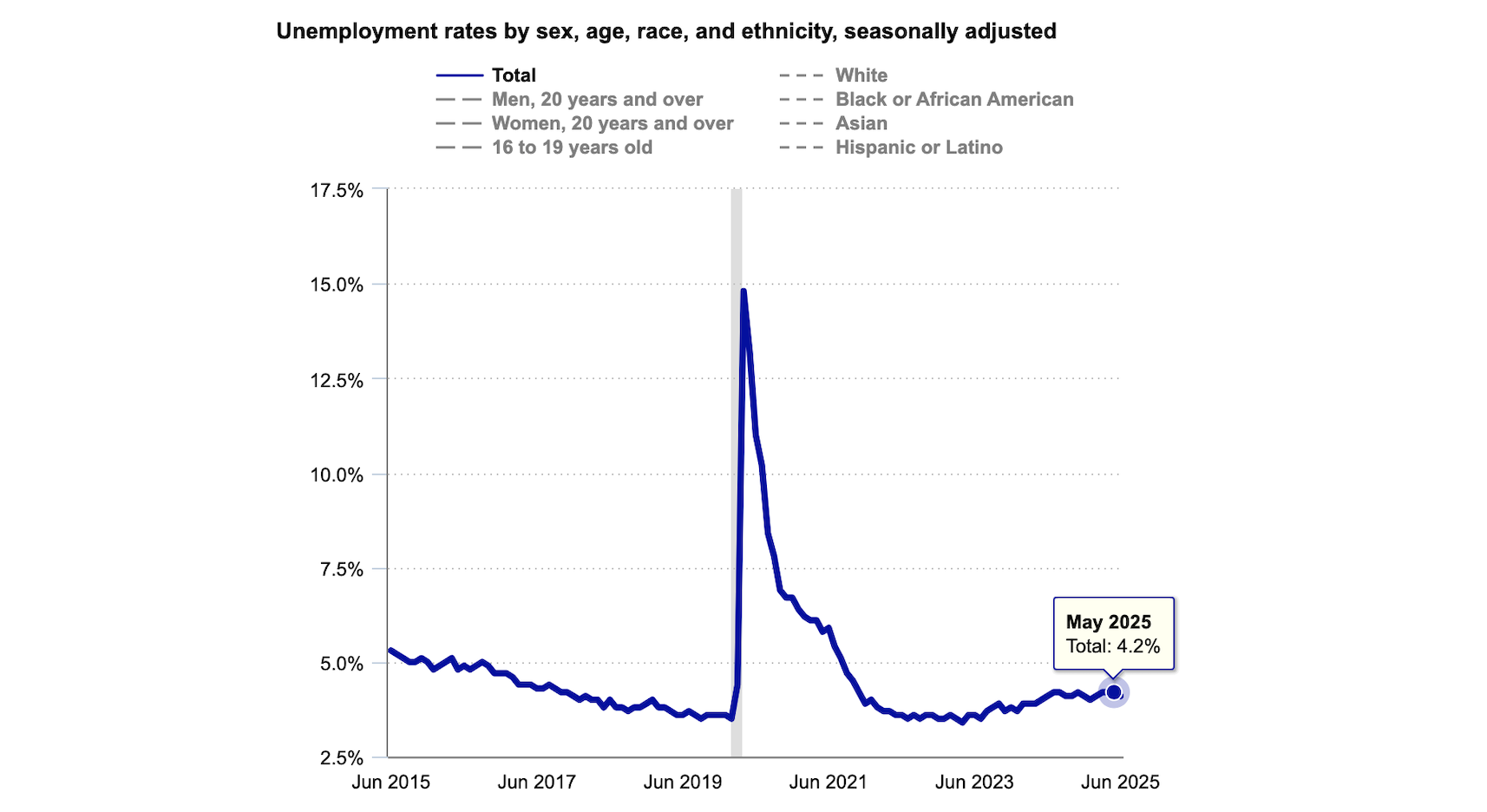
The United States Bureau of Labor Statistics sharply reduced their forecasts of newly created jobs by more than a quarter million positions in May and June.
https://img.lightshot.app/eGkTSiK4SYe9Pdzb9S5mDg.png
In June, BLS estimated that only 14,000 new jobs were created that month. By July, the unemployment rate rose to 4.2% or 7.2 million unemployed Americans.
In March 2026, the job market remained in a state of “low hires, low fires,” and the unemployment rate did not change significantly at 4.3%. However, what really makes us uneasy is the increase in long-term unemployment.
The portion of unemployed people without a job for 27 weeks or more currently amounts to 25.4% of all jobseekers. When there are millions of people looking for a job, it becomes essential to apply many times just to secure your chances.
The AI job application tools candidates already use
The category has matured fast enough to have tiers.
1. Aiapply
AIApply sits at the full-automation end: a candidate sets target titles, locations, and seniority, and the tool finds matching postings, rewrites the resume and cover letter for each one, submits the application, and adds interview prep on top.
2. Teal
Teal works one step back from that, as a job-search tracker with an AI resume builder that scores a draft against a specific job description, effectively showing the candidate what your ATS will see before they apply.
3. Jobright
Jobright leads with matching: an AI job board that surfaces high-fit roles from across the web and drafts tailored materials for them.
4. Kickresume
Kickresume stays closest to the document itself, generating polished resumes and cover letters from a job title upward.
Pricing runs from free tiers to roughly the cost of a streaming subscription. These are mainstream consumer products with millions of users between them, marketed openly on YouTube and TikTok, and the applications they produce arrive, by design, fluent in the exact vocabulary of your job description. If your postings are public, some share of this week’s applicants used one.
Automated screening created automated applying
That fluency is the crux, because the arms-race framing assumes the two sides want different things, and they don’t. Employers automated reading twenty years ago for a defensible reason: once job boards made applying nearly free, no team could read everything that arrived, so keyword screening became the coarse filter. Candidates then learned exactly what the system taught.
Resumes that mirror the posting’s vocabulary advance, and resumes describing the same skills in different words stall. Hand-tuning every application was the tax on getting seen, and the new tools pay that tax automatically. Applicant-side automation is downstream of employer-side automation, a rational response to it, which is why treating it as cheating to be caught misreads the moment. Both sides automated the same chore: producing and processing tailored documents at a volume no human can sustain.
What the tools actually broke was a proxy that was already leaking. Keyword match always stood in for competence plus diligence, and employers knew it. In Harvard Business School’s Hidden Workers research, 88% of executives said their automated screens vet out qualified high-skills candidates, rising to 94% for middle-skills roles, and those findings predate generative AI reaching applicants at all. AI tools narrowed the damage to one clean fact: the cost of vocabulary matching has fallen to zero, so vocabulary matching no longer separates anyone.
The employer side keeps automating too, with 77% of organizations in that same Workday report planning to increase AI use in hiring, a build-out HR Future has tracked in its coverage of generative AI in talent acquisition. Two systems writing and reading the same document at scale can coexist indefinitely. The only unstable position is asking that document to carry information it no longer carries.
What this means for your hiring stack
Start by testing what your screen measures. Take a live requisition, paste the description into any of the free tools above, and time how long it takes to produce a resume your system scores in the top decile. Minutes. Anything a free consumer app can saturate in minutes is measuring keyword density, and keyword density is now evenly distributed between your strongest applicant and your least serious one. The scan still earns its keep as a spam and hard-mismatch filter; it just can’t be the ranking signal that decides who a human meets.
Then push the checkable facts up and the prose down. Ask your screening vendor what the ranking model weighs, and whether weight can shift toward claims that are verifiable rather than phraseable: location, work authorization, licenses and certifications, years in a named role. Those survive automation because a writing tool can phrase anything, but it can’t mint a license.
Move the differentiating weight to stages that sample the work itself. Skills-based assessments and structured work samples are hard for an application tool to fake because they aren’t writing tasks, and structured interviews with fixed questions and shared scoring rubrics remain the cheapest well-validated signal most teams have, costing little beyond the discipline of writing the questions in advance. The capacity math should close the loop: automated first-pass reading saves recruiter hours, and if those hours don’t reappear as assessment and interview time for the shortlist, the stack got cheaper while losing accuracy.
A test to run this quarter
Pick one open requisition and run it both ways. Rank the pool with your current screen, and in parallel invite the same pool to a 20-30 minute skills assessment, then compare the two shortlists. The size of the overlap tells you, for your roles and your market, how much signal the keyword layer still carries, and it turns the argument above into a number your leadership can act on. The constraint that remains is cost, since assessments price per candidate and add friction, so sequence them after the checkable-fact filters rather than instead of them. The AI-written application is the baseline artifact either way. Build the stack so the stages that decide an offer are the ones no application tool can write.
Guest writer