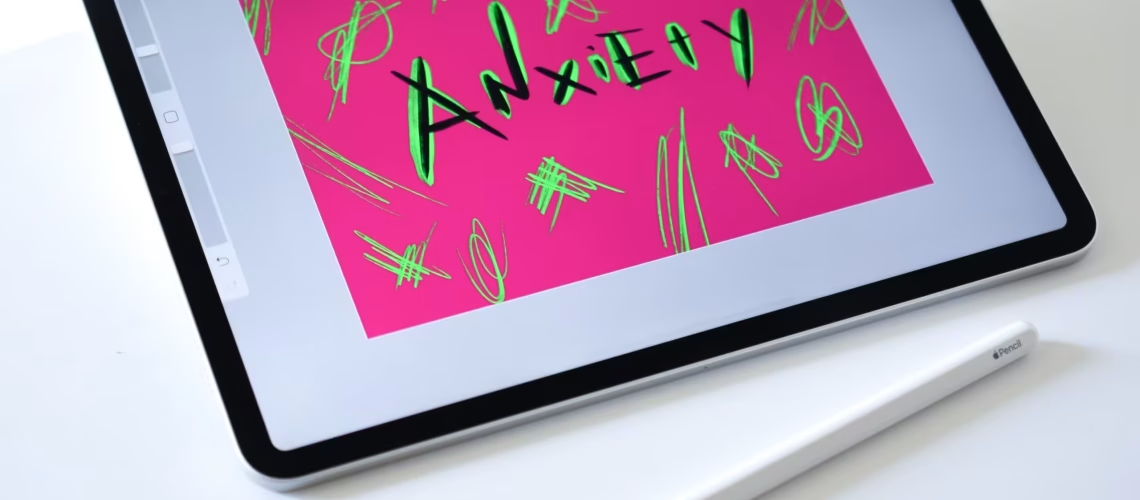
It is 2:00 am. In the blue glow of a laptop screen, a 22-year-old first-generation graduate is typing a question into a chat window. It’s not a technical query about spreadsheet formulas or coding languages. It’s a question they would never dare ask their manager, their recruiter, or even their peers:
“Am I already behind?”
If you want to understand the modern transition from education to the workforce, look past the headlines about technology. This is not a story about technology. It is a story about anxiety, access, and a professional world that has always rewarded those who already knew the rules. What has changed is where people are going to meet it.
The questions we’re too ashamed to ask
There is a specific texture to early-career shame that no management book quite captures. It lives in the body before it reaches the mind: the half-second pause before you speak in a meeting, the internal calculation of whether what you are about to say will reveal you. It is the performance of confidence so sustained, so carefully maintained, that by the time you get home, you are exhausted from the effort of seeming like someone who already knows.
We have a word for this now: imposter syndrome. But naming it has not made it easier to survive, and there is one consequence we rarely talk about. It makes people go quiet at the moment they need to speak the most.
That silence has a broader context. The World Happiness Report 2025, drawing on Gallup data, found that nearly one in five young adults reported having no one they could count on for social support; this figure 39% higher than in 2006. A generation more digitally connected than any before it is, by measurable evidence, one of the loneliest. The professional question typed into a chat window at 2 am often isn’t just a career question. For many, it is one of the only honest questions they feel safe asking at all.
This is what I think people misunderstand about the turn toward AI career tools. When a young professional opens a chat window at midnight, they are not searching for a smarter answer. They are looking for a safer place to ask one. Somewhere with no visible reaction or micro-expression to decode, no version of the question being quietly stored in a colleague’s impression of them. AI did not invent this need. It became the first professional space that many people have encountered, where the cost of not knowing something is nothing.
I learned this while building CareerSwift. I had assumed people would come for tactical help, such as CV formatting, keyword optimization, and ATS scores. I was wrong about what mattered most. What came back in reviews and emails was something different: not “your tool helped me beat the algorithm,” but something closer to “this was the first time I felt like I could ask without being judged for asking.”
A generation that inherited a broken feedback culture
It has become fashionable to describe Gen Z as impatient. A generation rewired by short-form content, conditioned to expect everything instantly. It is largely wrong, and it lets the hiring industry off the hook far too easily.
The job market this generation inherited has a broken feedback culture. A carefully made CV vanishes into an applicant tracking system with no explanation. Four-round interview processes end with “we’ll be in touch” and are followed by silence so complete you begin to question whether the conversation happened at all. And the scale of this is worth pausing on: where the average job opening received 93 applications in 2019, that figure has since risen to 244. For every hire, there are 243 rejections, and most of them are delivered in silence.
A Business Insider investigation labelled Gen Z the “ghosted generation,” documenting candidates who submitted hundreds of applications and received almost nothing in return.
Repeated, unexplained rejection produces numbness, a quiet erosion of self-worth, and eventually a learned instinct not to hope. Some leave altogether, turning to side hustles or opportunities abroad. Those who stay learn to treat the process as a numbers game because the system has given them no other framework to work with.
When you understand that environment, the turn toward AI looks less like impatience and more like pragmatism. If the official process won’t explain what you’re doing wrong, you find something that will. Seeking immediate, honest feedback from an algorithm is a rational response to a hiring culture that has normalised the absence of it.
The hidden curriculum and who was never taught it
For most professionals, career confidence arrives long before the first job interview. It travels through dinner table conversations, elite alumni networks, and parents who can casually explain what “culture fit” means before you ever walk into a room where it will be used to judge you. It passes from one generation to the next, as absorbed fluency in a language people never realize they are speaking.
First-generation professionals enter that same room without it. Consider the graduate who has never seen a polished, executive-level CV up close. The candidate who didn’t know salary negotiation was an option, let alone how to initiate it. Someone who performed brilliantly across three years of study, only to feel completely lost the moment they encountered a recruitment process made by people who had been prepared for it their entire lives. The maze was real. Everyone else had simply been handed a map at birth.
This is the context in which AI career tools are doing their most significant work, which goes largely uncelebrated. When a first-generation candidate receives instant CV feedback, mock interview practice, or strategic guidance on how to position their experience, something more meaningful than convenience is happening. The hidden curriculum is becoming, for the first time, genuinely accessible. That is a long-overdue correction.
What this tells HRs
If you are an HR leader or an internal coach, reading this might feel uncomfortable. If your youngest talent is taking their most vulnerable career questions to an algorithm before they bring them to you, that is worth sitting with.
This shift is exposing the silent gaps that have always existed inside our mentorship cultures:
- The perceived inaccessibility of senior leaders.
- The paralysing fear of seeming incompetent in front of a line manager.
- The absence of any structured, judgment-free space for early-career professionals to ask a basic question without incurring a cost.
These gaps did not appear when AI arrived. AI simply made them visible.
The opportunity hidden in the discomfort
The smartest HR leaders will use this moment to draw a clear line between what technology handles well and what demands a human being.
- Let AI carry the tactical. CV questions. Cover letter anxiety. Basic interview preparation. The 2 am spirals about whether a career gap will disqualify someone before they even get a conversation. These concerns consume enormous emotional energy, but they are also solvable with the right tool, at the right moment, without requiring a senior leader’s time or a junior employee’s courage to ask. Handing this layer to AI is an act of organizational care.
- Bring humans back for strategy. What remains (and what no algorithm can replicate) is the nuanced, deeply human work of genuine mentorship. How to navigate a difficult relationship with a line manager; how to position yourself for a promotion without alienating peers; when to stay, when to leave, and how to know the difference. The long-term perspective that only comes from someone who has lived through something like what you are facing. These are the conversations that change careers.
Meaningful mentorship was never meant to answer every question. The expectation that it should stretch human attention across tactical anxieties that leave little room for deeper work. AI has not replaced it. In making the tactical frictionless, it has cleared the space for the conversations that matter. The question for HR leaders now is whether they are ready to step into it.
We’re all still figuring this out
It would be easy to end this with a neat prediction about the future of work, or a grand vision of fully automated HR processes. But the most honest conclusion is simpler and less comfortable: nobody has fully worked out what good support looks like in a labour market changing this rapidly. Not HR directors, executive coaches, and AI founders.
Building CareerSwift never started with the technology. At the centre of every decision: the person at the laptop at 2 am; the one with a question they felt too ashamed to ask anyone else. That remains the only ambition that matters: a world where not knowing something yet marks the beginning of a conversation.
The tools are getting better. The more important work is making sure the world they operate in gets kinder.
Alex Nosik is the CEO of CareerSwift.